EPA AIM Act compliance software for HVAC contractors
Track EPA Part 84 leak-rate calculations, repair deadlines, verification windows, certified-technician requirements, and citation-backed records exports from the same operational data your HVAC team already manages. TuffOps Comply gives contractors HVAC EPA recordkeeping software without forcing another disconnected spreadsheet.
Structured refrigerant compliance records without a spreadsheet living beside your work orders.
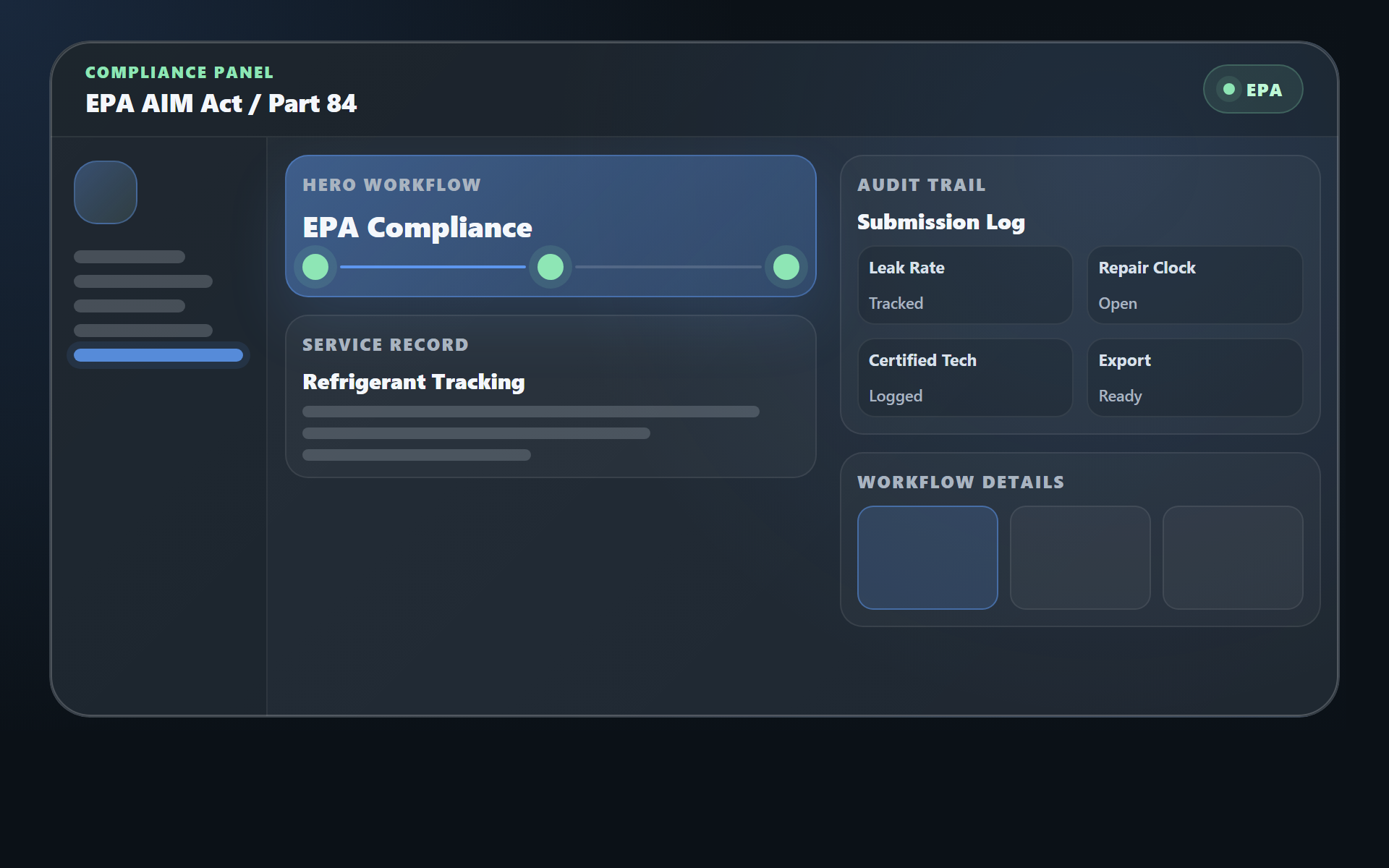
Keep refrigerant compliance records organized from day one
When leak rates, technician certifications, verification events, and repair deadlines live in different places, an EPA records request can take hours to reconstruct. TuffOps keeps those compliance details attached to the customer, unit, work order, and refrigerant activity that created them.
What happens without a compliance system
- Leak-rate calculations sit in spreadsheets or technician notes.
- Repair deadlines depend on someone remembering the right clock.
- Technician certification records are checked after the fact.
- Records exports require stitching together work orders, invoices, and files.
What TuffOps tracks
- Per-event leak-rate calculations with method and threshold context.
- Repair, initial verification, and follow-up verification windows.
- Technician certification checks for refrigerant repair workflows.
- Audit-ready exports tied back to the original compliance record.
Result: your office can answer compliance questions from operational records instead of rebuilding the history from scratch.
The AIM Act phasedown is in effect. Most HVAC shops are not ready.
EPA's 40 CFR Part 84 Subpart C took effect January 1, 2026. It changed leak-repair rules for appliances with 15 lb or more of regulated refrigerant, including calculation methods, repair deadlines, verification windows, and recordkeeping. Spreadsheets do not carry CFR references automatically, and paper service tickets are hard to organize when your team needs to show how a leak-rate method was applied.
Source context: EPA summarizes the Emissions Reduction and Reclamation reporting requirements, and the eCFR publishes the full 40 CFR §84.106 leak repair text.
Five things EPA can ask for — today — on any covered appliance.
These are core recordkeeping areas under 40 CFR Part 84 Subpart C as of the January 1, 2026 effective date. TuffOps helps your team keep the supporting records organized before anyone asks for them.
| # | What EPA wants to see | What "ready" looks like |
|---|---|---|
| 1 | Leak rate calculated on every refrigerant addition, with the right method applied on or after January 1, 2026 (annualizing or rolling-average). | A timestamped calculation for each refrigerant addition, with the method and Part 84 basis included in the record. |
| 2 | Repair started within 30 days of an over-threshold leak (120 days if industrial-process shutdown applies under §84.106(d)). | A repair record that shows the applicable deadline, the reason for that deadline, and the current repair status. |
| 3 | Initial verification within 30/120 days of exceedance, follow-up verification within 10 days of initial (§84.106(e)). | Two separate verification windows per repair record, each tied to the right event and CFR reference. |
| 4 | Certified technician on every repair per §82.161(a) and §84.106(c)(1). | A current §82.161 certification on file for every technician who handled refrigerant, with expiration dates visible before work is assigned. |
| 5 | Records exportable on demand — leak-rate calculations, repair records, verification methods, mothball periods, RLCA carve-outs, methodology changes. | An exportable records package that connects the major compliance fields back to the relevant CFR references. |
HVAC EPA recordkeeping software built from records EPA may request
TuffOps treats EPA AIM Act compliance as structured records your team can understand: units, refrigerant events, repair work, verification tests, technician certifications, and exports.
| Compliance area | What TuffOps captures | Why it matters |
|---|---|---|
| Applicability | Full charge, refrigerant type, appliance category, customer, location, and RLCA carve-out status. | Your team can tell which units need Part 84 review before a refrigerant event becomes a recordkeeping problem. |
| Leak rate | Refrigerant addition events, calculation method, threshold comparison, and the basis for first calculations after January 1, 2026. | Each refrigerant addition can produce a clear leak-rate record instead of another disconnected spreadsheet entry. |
| Repair episode | Repair start, deadline basis, industrial-process shutdown handling, mothball pauses, and extension request state. | The office can see the active clock and why the due date resolved the way it did. |
| Verification | Initial verification, follow-up verification, test timing, pass/fail outcome, and technician context. | Repair success is supported by the two verification records Part 84 expects for repaired leaks. |
| Export | Export-ready records for leak calculations, repair work, verification tests, mothball periods, methodology changes, and carve-out history. | When someone asks for documentation, the export starts from structured records already captured during operations. |
How TuffOps refrigerant compliance software helps
TuffOps Comply helps your team capture the Part 84 and Section 608 details that matter during normal service work, then keep those records ready for review, reporting, and customer questions.
Leak-rate calculations for each refrigerant event
Annualizing and rolling-average calculation options capture the method used and the Part 84 basis for first calculations after January 1, 2026.
40 CFR §84.106(b)(1) · §84.106(b)(2)30 / 120-day repair deadlines
Repair deadlines are calculated by appliance category, with support for industrial-process shutdown timing and a clear history of who changed the record and why.
40 CFR §84.106(d)Initial and follow-up verification windows
Track the initial verification window and the follow-up verification window separately, including changes caused by industrial shutdown timing or mothball status.
40 CFR §84.106(e)(1) · §84.106(e)(2)Mothball pause and resume history
When an appliance is mothballed, TuffOps records the pause and resume dates, updates open deadlines, and keeps the supporting history available for review.
40 CFR §84.106(d)(3) · §84.106(l)(10)Residential and light-commercial carve-out records
Document when a unit qualifies for the residential and light-commercial AC/HP carve-out, including the reason, who made the update, and the history of changes.
40 CFR §84.106(a)(3)(ii)Certified-technician checks
Refrigerant repair workflows can check for current §82.161(a) certification before work is assigned, with an audit history for certification exceptions.
40 CFR §82.161(a) · §84.106(c)(1)Repair-extension request packet
Capture the reason for an extension request, track the requested number of days, and keep the repair and initial-verification due dates aligned with the request status.
40 CFR §84.106(f)(1)(3)(4)Methodology-change tracking for acquisitions
When ownership changes or a leak-rate method needs to change, TuffOps records the prior method, new method, affected appliances, and the reason for the change.
40 CFR §84.106(b)(3) · §84.106(l)(3)Records export with CFR references
Export leak-rate calculations, repair records, verification methods, mothball periods, carve-out history, methodology changes, and extension requests with supporting CFR references.
40 CFR §84.106(l) recordkeeping familyPart 82 and Part 84 context
Keep Part 82 and Part 84 context visible on the appliance record so your team understands which requirements apply and why.
40 CFR §84.120 (dual-framework anchor)Connected workflow
From refrigerant event to audit-ready export
The compliance record starts where the work happens. TuffOps connects the field event to the unit, resolves the applicable compliance rules, tracks the required follow-up, and keeps exportable evidence attached to the same customer and equipment history.
Add refrigerant
The event is tied to the customer, unit, technician, and refrigerant details.
Calculate
TuffOps records the method, threshold, and Part 84 basis for the leak-rate result.
Track clocks
Repair, initial verification, follow-up verification, and extension timelines stay visible.
Export records
The audit packet is generated from the same structured records your team used.
Why TuffOps Comply, and not what you're using now.
Your dispatch, billing, and CRM tools can keep running exactly as they do today. TuffOps Comply adds the refrigerant compliance layer those systems usually do not cover in detail.
| Spreadsheets / Paper | ServiceTitan · Housecall Pro · Jobber · FieldEdge | TuffOps Comply | |
|---|---|---|---|
| Leak-rate calculation for each refrigerant event | × | × | ✓ |
| 30 / 120-day repair deadlines with industrial-shutdown timing | × | × | ✓ |
| Initial + follow-up verification windows (§84.106(e)) | × | × | ✓ |
| Mothball pause/resume history | × | × | ✓ |
| RLCA carve-out workflow | × | × | ✓ |
| Certified-technician tracking before refrigerant repair | manual | partial | ✓ |
| Repair-extension request packet (§84.106(f)(4)) | × | × | ✓ |
| Records export with CFR references | × | × | ✓ |
| Helps prepare for an EPA records request | × | × | ✓ |
Comparison reflects publicly documented capabilities of each platform as of May 2026. Many TuffOps customers continue using their existing field service software for dispatch, billing, and CRM while using TuffOps Comply for refrigerant compliance records.
"TuffOps is an absolute gamechanger for us. It surpassed our high expectations in every regard. No more paper and better service for our customers."
How "audit-ready in 30 days" actually works.
A structured onboarding sequence helps your team move from scattered records to a working compliance process. You bring your equipment list and refrigerant history; we help organize the records, train the team, and review the export together.
Data import & unit catalog
Import your customer and equipment lists. Tag every appliance with charge size, refrigerant type, equipment category, and RLCA eligibility. Catalog gaps surface immediately.
Workflow training
Train your office and field crews on leak-repair records, technician certification checks, mothball pause/resume, and industrial-shutdown timing. Permissions are configured by role.
Records export dry run
Generate the §84.106(l) records export against your imported history. Walk through it together as if EPA had just asked. Identify and close any gaps.
Audit-readiness review
Final walkthrough with our team. Review the records in scope, confirm remaining gaps, and leave with a clear readiness summary for your files.
Included records
What the AIM Act audit packet can include
The TuffOps compliance export is organized around the records a contractor needs to review quickly: unit details, refrigerant events, repair history, verification records, and supporting notes.
- Unit
- Customer, location, category, charge size
- Refrigerant
- Type, amount, service event, technician
- Scope
- Part 84 applicability and carve-out status
- Leak-rate calculation method and result
- Repair deadline and extension basis
- Initial and follow-up verification details
- Mothball pause and resume history
- Certified-technician status
- Methodology-change history
- RLCA carve-out audit trail
- CFR reference context in exports
EPA and eCFR source links for AIM Act recordkeeping
For buyers comparing HVAC AIM Act software, these public resources are useful starting points for understanding the rules TuffOps Comply helps organize into day-to-day records.
EPA ER&R reporting resources
EPA explains reporting resources for the Emissions Reduction and Reclamation rule under 40 CFR Part 84, Subpart C, including leak repair reporting scenarios.
40 CFR §84.106 leak repair
The eCFR text covers applicability, leak-rate calculations, repair timing, verification tests, mothball periods, and recordkeeping for affected appliances.
Section 608 technician certification
EPA describes technician certification requirements for people who maintain, service, repair, or dispose of equipment that could release refrigerants.
Frequently asked questions about EPA Part 84 compliance software
What if I'm already on ServiceTitan, Housecall Pro, Jobber, or FieldEdge?
You can run TuffOps Comply alongside your current field service software. Your existing platform can keep handling dispatch, billing, and CRM while TuffOps Comply keeps the refrigerant compliance records organized.
Is this Section 608 compliance software too?
TuffOps Comply is focused on AIM Act and EPA Part 84 recordkeeping, but it also helps keep Section 608 technician certification context visible when refrigerant repair work is assigned. That makes it useful for contractors who want AIM Act software and Section 608 compliance software support in the same operational workflow.
What if my shop only services smaller or residential systems?
Part 84 leak-repair obligations depend on the appliance, refrigerant, charge size, and carve-out status. Appliances below the 15 lb full-charge threshold are outside §84.106, while qualifying residential and light-commercial AC/HP appliances may be documented through the §84.106(a)(3)(ii) carve-out. TuffOps Comply keeps that applicability context on the unit record so your team can explain why a unit is or is not in scope.
How does this help with an EPA records request?
TuffOps Comply is designed to support the 40 CFR Part 84 Subpart C records around leak repair, verification, recordkeeping, methodology changes, mothball periods, and RLCA carve-outs. We'll walk through your specific needs and show the records export against realistic scenarios. Areas such as refrigerant reclamation under §84.112, fire suppression under §84.110, and EPA-submitted data under §84.118 can be reviewed separately.
Do I have to switch off my current field service software to use this?
No. TuffOps Comply runs as an add-on alongside whatever you're using today. If you're also evaluating TuffOps for full work-order operations, we can discuss that separately, but the compliance product can stand on its own.
How much does TuffOps Comply cost?
Comply is $15 per field technician per month as an add-on to the TuffOps Starter plan, and included at no additional cost on the Pro and Enterprise plans. Office and dispatch seats are free on every plan. A 6-tech shop on Starter pays $354/month for TuffOps + $90/month for Comply — a small operating cost compared with current Clean Air Act administrative penalty levels that can reach $59,114 for some provisions. Full plan breakdown on the pricing page.
Can I see the records export before I sign anything?
Yes. The 20-minute walkthrough shows the records export against sample data. Bring a real scenario — an over-threshold leak, an ownership change with a methodology update, or a mothballed unit — and we'll show you what the export looks like.
What makes this different from generic HVAC compliance software?
Generic HVAC compliance software often stores notes, files, or checklists. TuffOps Comply is organized around refrigerant compliance records: appliance applicability, leak-rate calculations, repair deadlines, verification windows, technician certification, carve-out status, methodology changes, and exports with CFR references.
Who built TuffOps Comply?
TuffOps is built by Caribe Solutions, headquartered in Redmond, Washington, and used by HVAC contractors across the continental United States and the Caribbean. TuffOps Comply was reviewed against 40 CFR Part 84 with consultant input, and each major workflow is tied to the relevant CFR references. For a deeper background read, see our guide to EPA Section 608, the AIM Act, and Part 84.
Where in the country (or world) do you support customers?
Anywhere in the continental United States, plus the U.S. Virgin Islands and Puerto Rico. Onboarding, training, and support are remote-first — we run scheduled video walkthroughs and the platform is web-based, so geography is not a constraint. For Pacific Northwest shops who want an in-person walkthrough, we are based in Redmond, Washington and happy to come on-site when it makes sense.
Get audit-ready in 30 days.
Book a 20-minute walkthrough. We'll show the leak-repair workflow, the records export, and the supporting CFR references against a scenario from your shop.
Book your compliance walkthrough →Explore TuffOps solutions
Explore the connected workflows that help HVAC teams replace paper records, phone tag, and disconnected tools.